
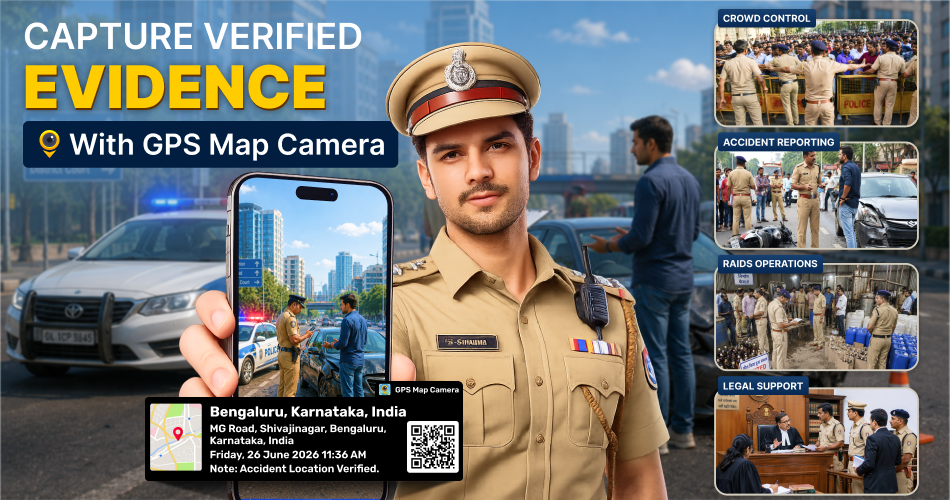
Police work does not happen in offices. It happens on roads, at crime scenes, during patrols, and in public duty. Every action can be questioned later — by seniors, courts, or the public. Verbal explanations are not enough. What matters is time-bound and location-based proof. GPS Map Camera helps police turn field photos into verified records that show where and when an action happened.
1. Where Traditional Documentation Falls Short
Police use written reports, logbooks, and normal photos. These have gaps:
- Photos without confirmed location
- Doubts over time and the order of events
- Hard to prove on-site presence
- Extra explanations during inquiries
2. How GPS Map Camera Adds Real Proof
It adds exact location, date, and time to every photo. The image becomes a strong record. No memory issues, no confusion about the spot, and reports that match reality.
3. Stronger Crime Scene Records
GPS Map Camera helps police capture scenes with verified location and time. With location-stamped visuals, case files become more reliable for both investigators and courts.
4. Verifiable Patrolling and Night Duty
Patrols are often questioned in reviews. GPS Map Camera proves which areas were covered, the exact patrol time, and real on-duty presence. Helpful for supervisors checking patrols across zones.
5. Crowd Control and Public Events
In rallies or festivals, officers can record crowd conditions, deployment points, and time-stamped photos. This protects officers and the department.
6. Accident Reporting and Traffic
GPS Map Camera shows the exact accident spot, confirms reporting time, and strengthens challans with proof. This reduces fake claims.
7. Raids and Field Operations
In raids and seizures, records must be strong. GPS Map Camera proves the operation site, real-time action, and seizure details — useful in reviews or legal cases.
8. Officer Protection
It gives proof of duty done, supports officers during inquiries, and reduces dependence on witnesses. The photo becomes neutral, self-speaking proof.
9. Faster Supervisor Review
GPS-tagged images allow supervisors to quickly verify field actions without waiting for lengthy reports. This speeds up decision-making and improves operational efficiency.
10. Fits Modern Police Standards
Modern policing focuses on digital records, transparency, and evidence-based reports. GPS Map Camera fits this shift without changing the workflow.
Final Thought
For frontline officers, clarity is key. GPS Map Camera turns routine field photos into trusted records. In a job where every action matters, having proof on the photo makes policing more transparent, professional, and protected.